


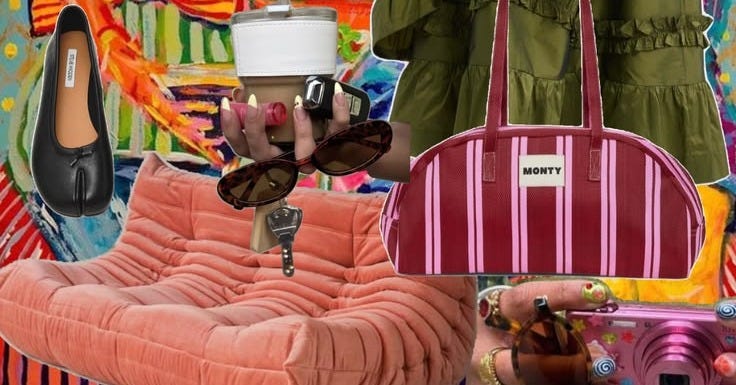
Can I be mean for a sec? If there is one phrase I’m sick of hearing online, it’s cool girl.
5 brands the cool girls are wearing this summer
Here’s the habits every cool girl sticks to
7 cool girl outfit ideas
Cool girl shoes of the summer
I could go on. The term has been co-opted by influencers, brands, and AI slop, and I feel like I’m being gaslit by my for you page. Not because the things or brands or people involved aren’t, in my opinion, ‘cool’ (many are). But the naming, framing, and claiming of them as a collective makes it something else entirely. The complete commodification of the cool girl aesthetic makes it entirely uncool. Here’s why.
Cool since 1904
The cyclical nature of cool isn’t a new point of discussion. In 1904, German philosopher George Simmel identified what makes fashion trends work. In his essay, The Philosophy of Fashion, he outlined two drives.
The drive to imitate: To be recognized as a cool girl, you’re gonna need to imitate a very specific and shared visual language. Buy the same brands, go to the same places, take up the same activities. Imitation is a shortcut that provides instant recognition and a sense of belonging.
The drive to distinguish: At the same time, to be cool is to be different. The whole aesthetic is driven by the appearance of being a trendsetter. Effortless and ‘not like other girls’.When a certain object or look becomes mass-produced and overly shared, it loses its cool. That’s the irony and tension between these two drives. However, in 1904, this process may have taken years. With social media and the ability to ask an LLM for recommendations, the cool-to-saturated cycle can take just weeks.
Open up, here comes the tasteslop
Emily Segal defined ‘tasteslop’ in a recent essay.
It’s such a beautifully simple moniker for the era we are in right now with presenting ourselves online. What I took away from the essay is that tasteslop occurs when we remove the requirement that taste be earned. When what’s tasteful or cool is obvious, explicit, or seemingly unanimous. She writes:
if taste classifies (and classifies the classifier), tasteslop is what happens when the classifying function is automated, overly explicit, or reduced to spitting out rote taste tokens.
Creating content that uses the word ‘cool girl’ serves the algorithm. Social media platforms rely on categorizing content to serve their users. They love repeatable formats. Categorizable content gets better engagement, better engagement means better numbers, and creators rely on better numbers to make their money. In this economy, I certainly don’t blame them.
Many of these creators have developed genuine taste. They build large followings based on their unique personalities, styles, and recommendations. But when we see the same items, brands, and text-over-screen labelling, choosing what is ‘cool’ becomes obvious.
We are no longer really choosing.
Cool can’t be bought or borrowed
It’s a bit like being funny. Some people are born to it so naturally. People have different senses of humour. Not everyone finds the same people funny. Different people and things can be cool to different audiences. You can borrow a joke, but if you aren’t funny, you can’t follow it up with a witty comment or self-deprecatory quip.
Cool girl posts, like much of the internet, seek to gain social currency by giving people the shortcut to being cool. But these brands and creators are selling snake oil. Even the richest, most powerful people in the world, with all of the advice and guidance and stylists and tastemakers at their disposal, simply don’t have access to being cool.
I think that’s why Taylor Swift wrote that line about Charli XCX. ‘You call me boring Barbie when the c*kes got you brave’ (deeply uncool). Cool is very accessible to Charli, it’s just happening to her. Taylor, with her many talents and billions, and lyrical genius, still cannot access it. Don’t come for me Swifties.
And just look at the Mark Zuckerberg rebrand or Jeff Bezos sponsoring the Met Gala. Cool can’t be bought.
Cool is in the eye of the beholder
Trying to define cool is like trying to catch smoke in a fishing net. A definition is the wrong medium. While entirely subjective, there are, of course, things that people almost unanimously agree are cool. But, as Simmel set out, cool is a moving target.
The only way, I think, to be truly cool is to develop a deep understanding and appreciation for the things you invite into your life. Treat what you wear, what you buy, what you eat, and where you go as a form of self-expression. Crucially, this can’t be performative. How you present to the world, and the things that make up this presentation, must hold meaning for you.
For example, I wear a lot of fringing, velvet, rhinestones, platform shoes, and statement jewelry. This made up about 70% of my mum’s wardrobe when I was younger. I specifically remember in the early 90s she wore a black slashneck dress studded with rhinestones to see The Village People. While I never inherited the actual dress, I was lucky enough to find one very similar in a Kate Moss x Zara studio collection. I love it.
Not everything needs to have deep nostalgia, of course. I also buy and wear a lot of Ganni, to the point where a statement collar reminds people of me and my personal style. But I have built an understanding and even a relationship with the brand. It feels like me.
Derek Guy explains here that cool comes from lived experience and culture.
I love Polo Ralph Lauren not because Ralph references WASP aesthetics, but because when I was going to dance clubs as a young adult, the best and coolest dancers wore Ralph Lauren from head to toe.
But when we stop building on this relationship with style, taste, and cool, and simply fetter our discretion to the algorithm, we risk burning through aesthetic cycles faster than Shein. And I guess that’s the point. When you deeply understand what you find cool, you become satisfied with slow discovery. You wait for the thrill of finding a dress that looks just like your mum’s in the 90s. You gasp at the perfect, nostalgic Ralph shirt in the vintage shop. You buy more meaningfully, and you buy less.
I can’t tell you the formula for cool, and neither can 1m+ Instagram reels. It is so deeply personal. You don’t buy it or borrow it. You can only find threads from your lived experience to weave into your very own kaftan of cool. You are already a cool girl. Empty your online baskets.